Monday, December 07, 2015
Prayer as a Response to Crisis
King Asa of Judah prayed as he prepared to lead his army against a more powerful military force: “Then Asa called to the LORD his God and said, ‘LORD, there is no one like you to help the powerless against the mighty. Help us, O LORD our God, for we rely on you, and in your name we have come against this vast army. O LORD, you are our God; do not let man prevail against you” (2 Chronicles 14:11). The king appeals to God’s covenant with his people but also notes God’s love for justice with the observation that God will “help the powerless against the mighty.” He calls for God to remember his relationship with the people of Judah and the lineage of David. We remind both ourselves and God of our relationship when we pray. This past week, as many stated that they were praying for families of the victims of the shooting in San Bernadino, California, others scoffed at the concept of prayer as a response to crisis. The Bible testifies that prayer indeed is an appropriate response, when combined with faith, genuine concern, and faith-based action. Terrorists and other criminals often attack the vulnerable and people engaged in activity (like celebrating at a Christmas party) that compromises their alertness. When we pray, like Asa we confess our helplessness, but also ask for guidance so that we may respond effectively and appropriately. When we pray, we call upon God to remember his zeal for justice. We ask him to make right what has been violated. We pray in the name of Jesus Christ, and that fact must remind us that whatever we do from that point, we must remember that we act as Christians. Some seem to perceive all prayer in response to crisis as glib and meaningless. Perhaps some do say they are praying or will pray as a reflexive response, much as we say, "I'm great!" in response to a greeting of "Hi! How are you?" even when we may be having a very bad day. However, I'm convinced that many pray in challenging times with a conviction that our creative God will find a way to execute justice and bring right to an scenario that is entirely wrong. Let us be sure to pray if we say we will pray, and be sure to follow our prayer with positive actions. Our response will impress others as the way that Christians react, whether we respond well or poorly. May we pray and act in response to crisis and injustice in ways that testify to our neighbors about the power of God and the love of Christ.

Thursday, December 03, 2015
Taking Time to See the Greatness of God
God’s spectacular creation has overwhelmed me at times. The total darkness of an overcast night in the Mojave desert far from any light, the snow-capped mountains that surround Kabul, Afghanistan, the crystal blue of the Adriatic sea, and the myriads of stars visible in the sky above Arizona’s Sonora desert have all awakened in me a sense of awe. On the other hand, hiking trails in Arizona and Tennessee mountains or running on German forest trails confronted me with vibrant green foliage punctuated by brightly blooming flowers. A deer pausing as it attempted to avoid my notice or a squirrel scurrying up a tree reinforced my wonder at God’s creative power. I understand, however, all too well the point that some rabbis suggested when they said that God had trouble getting Moses’ attention because he was too focused on the sheep. I wonder how many of us have the same focus on everyday responsibilities that distract us from a burning bush equivalent, a sight or experience that would envelop us in awareness of God’s otherness and nearness if they would only pause to notice. I have been distracted in that way. Besides my running, my reading has also reminded me that God’s glory surrounds me. One story that has helped me to regain my bearings is Charles Dickens’ A Christmas Carol. Each year I search for a new film version of it in hope of a fresh reminder of proper priorities. Occasionally, I encounter people who I expect to appreciate God’s wonder because of their experiences, but who seem to have a spiritual twin of tone deafness. It takes me aback, and usually jolts free a memory of my own obtuseness in the presence of wonder. I have had trouble lifting my eyes to see the beauty around me after several jarring events in my life. I’m thankful for the times I have opened my eyes to behold the wonder. “The heavens declare the glory of God, and the sky above proclaims his handiwork” (Psalm 19:1). Pause and marvel at the wonders God has created.

Saturday, April 12, 2014
Preparing for Disaster
I return after an absence of several eventful months. My chaplain ministry continues to give me opportunities to serve those who give themselves to serve others. At the same time, I hope for opportunity to serve more. The rough draft of my book on prayer nears completion even as I intensify my search for preaching and teaching opportunities. This last week I was reinvigorated by hearing speakers discuss preparation for and ministry to people overcome by natural disasters. Illness and unexpected loss of a house or business damages one's spirit. One survives the storm through prayerful preparation, attributing proper value to material possessions, and by having the right amount of insurance. Insurance may be flood, fire, or earthquake related; it also can be soul-directed when one evaluates his or her relationship with God and acts to improve it. 1 Peter chapter three describes how Noah survived a world-wide flood and compares it to Christians being saved through baptism that confesses one's allegiance to God and faith that realizes the implications of Christ's resurrection from the dead.
Wednesday, November 20, 2013
Lincoln's Gettysburg Address: A Reflection
Though he said that the "world will little note nor long remember," we still recall the speech that Abraham Lincoln delivered at Gettysburg 150 years ago. He honored Soldiers, most whom we would call "citizen Soldiers" today, who perished in combat in and around that small town. I visited the Gettysburg battlefield three years ago. It remains a somber reminder of what price we may pay when we fight for principles in which we believe. We have a responsibility to know what we believe and how important those beliefs are. Some beliefs are in fact based in falsehood; they survive only when fed with erroneous information and emotion, or when lack of information allows their sustainment. Others have little consequence; in the big picture of history, it makes little difference whether the Boston Red Sox won the World Series this year or if the Atlanta Braves will do so next year. Some beliefs are philosophical: The nature of freedom, economic theories, the meaning of love. Sometimes they are difficult to establish as true or valid, but still their means of execution has a lasting impact on our lives and our history.
A copy of Lincoln's Gettysburg Address hangs on the wall in my office at home. It reminds me that some principles are worth defending. Lincoln's words remind me that the man who spoke them endured merciless ridicule and cruel slander as he navigated our nation through its most tortuous years. We forget the bitter opposition he experienced even in the North when we regale him as perhaps our greatest President.
Abraham Lincoln called the nation to action with him speech. He admonished his countrymen to engender "a new birth of freedom." He implied that freedom best survives in a democratic republic. We have opportunity to influence events in our nation. We may speak and write; we can assemble and we can vote. Our freedom has its best opportunity to survive when we use those privileges with respect for truth and the right of others to express their opinions. Suppressing the rights of others historically has a tragic trend of sad consequences when the other party gains power.
Let us resolve that we will treat one another with respect and that we will listen to one another. Some principles are worth defending with our lives. We will thrive as a society when we defend truth, life, and freedom.
Thursday, November 14, 2013
Regaining Spiritual Balance
I read an article recently entitled "You Can't Run on Pop Tarts." It was a great article about living a balanced spiritual life. I read it as a fifty-ish person who runs 20 to 30 miles a week, usually fueled by a breakfast of a banana and two Pop Tarts. I watch what I eat more carefully at other meals, having reduced intake of red meat and regulating caloric intake. I replied to the article; this post is an expansion of my response.
As we run the race of life, we encounter obstacles that we must resolve. Activities, relationships, and work may slow our pace. We pause to work on these distractions (some of which have inherent positive value) and may have trouble returning the path we want to run. Sometimes work demands our attention. Supervisors want to increase productivity; that may mean that employees work harder or longer. It may also invite ethical challenges - taking a short cut that reduces value but increases the volume produce, stealing a competitors formula to enhance our own product. We wake up one morning and realize that we run the race of life with the goal of getting promoted, getting a raise, or earning a pension. Values have vanished from our metaphorical wardrobe; family, faith, and integrity have diminished roles when we make choices in time use or moral choices. The same dilemmas may emerge in regard to recreational activities and relationships. We have a sense that we have lost our way.
How may we regain our spiritual balance? First, we identify the distractions that keep us from living a spiritually healthy life. A biblical passages that urges running with our eyes fixed on Jesus (Hebrews 12:1-3) precedes that admonition by telling us to get rid of what holds us back or obscures our focus. A husband may have to cut down the number of hours he spends watching sports on television or playing with friends to improve his marriage. A teenager may have to distance herself from a "friend" who tempts her to compromise her values. Second, we associate regularly with other believers in worship and study activities that will help us improve our focus (Hebrews 10:25). It's hard to run alone; although I frequently run trails alone, the time goes much faster and I run faster when I run with others. The same principle applies to living for Christ. Although time in prayer alone is critical, the affirmation received from worship and fellowship in Christian assemblies helps bolster faithfulness to Christ and to the values contained in his teachings. We become more accountable through such association and so make decisions in a more thoughtful manner. Third, taking in regular amounts of Bible study seasoned with prayer will greatly increase the probability of our crossing the finish line and receiving the prize laid up for us in heaven (2 Timothy 4:1-8). Reading all the Bible systematically will decrease your straying from your path. It will keep you from focusing on a sliver of truth rather than the Christ who empowers.
We can't live a spiritually balanced life that is fueled only by televangelists and contemporary Christian music. These "spiritual Pop Tarts" may have some value in pointing us to Jesus and the Bible, but they cannot replace the accountability and affirmation gained by regular attendance at Christian worship assemblies and Bible studies. Regular Bible study and prayer remind us where the boundaries lie and help us to stay on the path to a life that is eternal in quality now as well as in duration.
Monday, November 11, 2013
Veterans Day A Year After Deployment
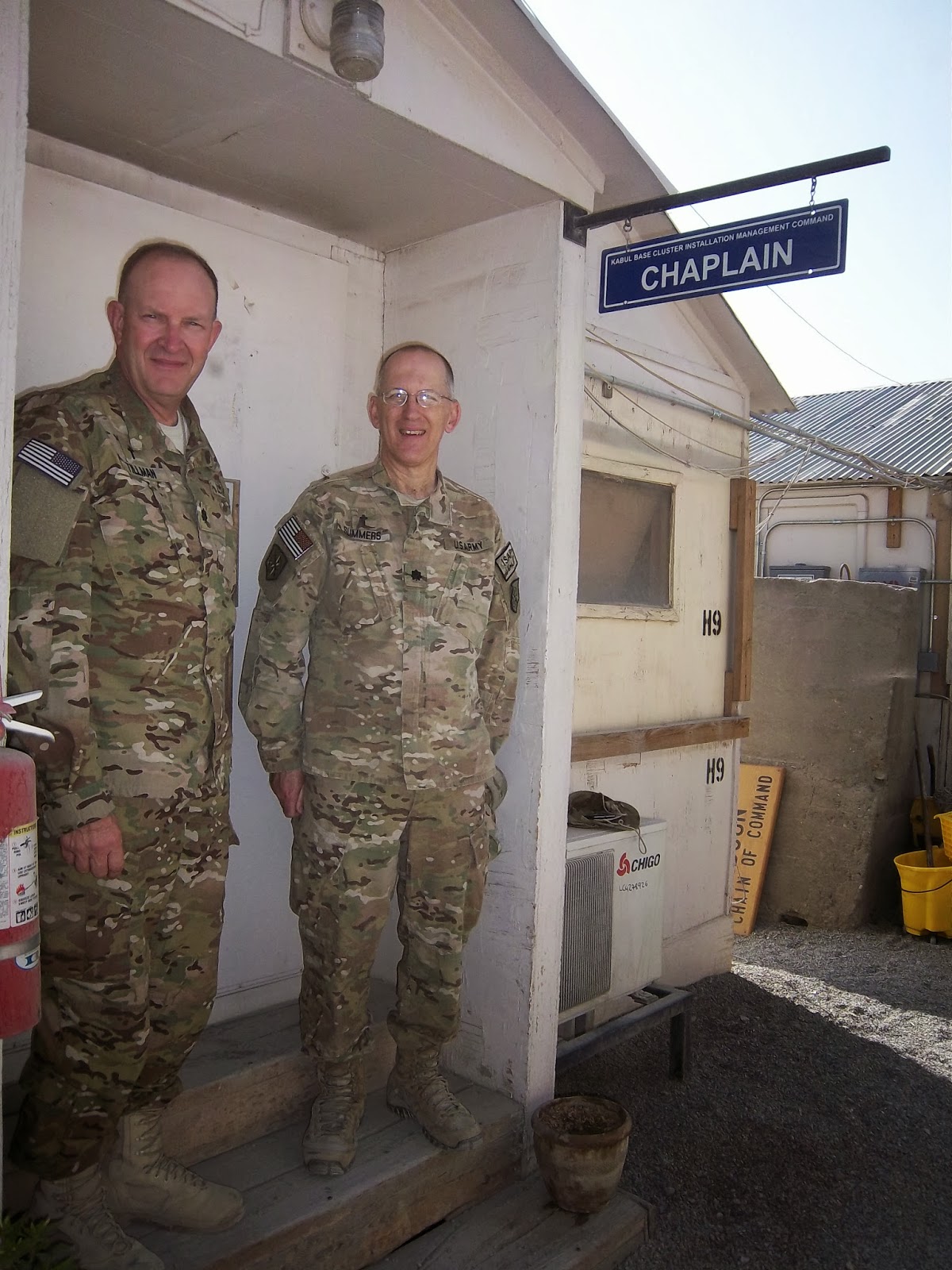 Veterans Day this year is much different for me. A year has passed since my return from Afghanistan. The picture was taken near the time of my departure. My replacement and I posed on the steps of our office building for the picture. When I arrived there, I had a vision for my ministry. I accomplished that mission with the help of a gifted and highly experience Chaplain Assistant. Randy had been there before. He had a sense of what was safe in planning our travels that I admired. We worked with Chaplains from other branches of our nation's military and Chaplains from Coalition Forces allied with us as well in providing religious support to brave men and women who had traveled thousands of miles from home. That responsibility for training many of those Chaplains and counseling those men and women helped me grow as a leader. I returned to a different world. Going from monitoring a large number of diverse worship services, preaching two to four times a week, teaching and training, planning with a highly skilled group of fellow staff officers every day to trying to explain that leadership experience to potential employers whose concept of I did there is much simpler than what actually happened has been difficult. I have maintained the running regimen I followed in Afghanistan. Running has made the transition easier. Writing a book has also helped (It's almost ready.). Singing and Bible study in a congregational setting has kept me spiritually balanced also. My wife's support has been phenomenal. Veterans return from their war experiences transformed. Some are scarred; all have changed. We all need prayers, love, and occasionally help in reintegrating. So on Veterans Day, express your gratitude. It helps the veteran to hear someone say, "Thank you." But also search for a concrete way you can help a veteran succeed in the next chapter of their story.
Saturday, October 19, 2013
A Fulfilling Week
Last week I participated in several events from which I gained great inspiration. A week ago, I spoke about Jeremiah's prayer in Jeremiah 12 as an example of "The Power of a Praying Man," a truth that might at first glance seem ironic given the content of his prayer. Missionaries to Scotland and Brazil also participated in the event; their insights helped me tremendously. This past Monday morning, I attended a church history workshop at the old Mars Hill (Alabama) Church of Christ building. It was constructed in 1904; Evangelist T.B. Larimore preached there numerous times. In addition to learning about the history of churches of Christ in Mississippi and the life of a student of Larimore's who had great influence among rural churches in Middle Tennessee and Northern Alabama a hundred years ago, I also got to lead those assembled in singing "Where the Gates Swing Outward Never," a rousing hymn that eagerly anticipates Heaven. On Tuesday Night, I participated as an alumnus in an event for prospective students at Harding School of Theology (http://www.hst.edu), meeting with the prospective students at a dinner and then sitting on a panel to discuss how attending the school has affected my ministry. Among the insights I left with them was not to assume that they know how their life will unfold, but to lay a foundation by their choice of schools and courses that would allow them flexibility and the optimal opportunity for ministry.
Monday, September 23, 2013
Remembering a Great Songleader and Preacher on His Birthday
James R. Greer (1904-1995) preached in Helenwood, TN, near Oneida when I was in elementary school and my father preached at Oneida Church of Christ. Brother Greer would have young boys like myself stand beside him sometimes as he (we) led singing so we could get the feel of it. Other than sitting beside my mother at church and listening to her beautiful alto voice, James Greer probably influenced me to love singing in church at an early age more than anyone else. In the mid-80's, I preached the homecoming gospel meeting at Oneida. James Greer came from Nashville, now in his eighties, accompanied by his wife, a long-time college librarian at what is now Lipscomb University, who had not always been able to accompany him to Helenwood years earlier. He directed singing on Sunday night. He needed help getting to the podium, but then remarkably he straightened up and that booming, beautiful voice led the congregation. During the breaks in singing for prayer and, of course, preaching, he feebly made his way to the pew behind the pulpit. But while singing, it was as if thirty or forty years fell away from him. His love for Christ was obvious in his service to the church as a domestic missionary, preaching to small church plants and inspiring their members through word and song. Today would have been his birthday. I remember him, and breathe a prayer of gratitude to God for this man who took the time to teach young boys how to stand before the church and learn to lead and to learn to love singing praises to God.
Wednesday, August 28, 2013
The Lessons of Memorials
Memorials remind us of what we value. They preserve memories of heroes or moments that changed history. This past week I ran on a trail alongside the Potomac River. As I ran, I could see the dome of the U.S. Capitol, the Washington Monument, and the Jefferson Memorial on the side of the river. George Washington's courage and dedication to his people still resonate today. Jefferson's writings still inspire. I walked the halls of a building whose walls feature paintings and plaques that describe heroic acts by American military personnel. I stood in a room and read the names of men and women who died suddenly as a terrorist-piloted airplane plowed through that building at that very spot. That tragedy and other similar events the same day shocked our nation and changed our attitudes toward liberty and security. The memorial, however, speaks to the loss of human beings who were dearly loved and highly valued by their co-workers and families. I said a prayer for those families as I stood there.
These memorials challenge me to treasure each day and to use those days more wisely. They tell stories of pain and terrorism overcome by courageous acts and a determined spirit. They remind that tragedy scars the soul even as it strengthens the survivor.
Our decisions and our actions lay foundation for memorials to our lives. What lessons will your memorial teach?
Saturday, August 24, 2013
Following Elijah, Not Jonah
Several weeks ago I asked for prayer. Since then, a short-term work assignment has kept me quite busy as I adapt to a senior supervisory role. During that time, I've also grieved as I've read news stories telling senseless violence - teenage boys killing an aged World War 2 hero; different teenage boys killing an Australian college athlete who was a student in our country, killing him because they were bored; and allegations of chemical warfare in Syria. I've also notice what appears to be an increasing militant opposition to Christianity and its values. This opposition sometimes presents itself in ways that threaten the free expression of religious practice by Christians. While Coptic Christian churches burn in Egypt, in America actions by churches are scrutinized for failures in political correctness. I've been discouraged also by Christians who act, speak, and write with apparent hatred for those who disagree. That is not my goal here. Jesus taught his disciples to love their enemies. As Christians, we should act with compassion and listen carefully to those who seem to oppose, to make sure that we understand correctly what they say. We should examine our actions, and the motives for those actions. We should avoid following in the steps of the prophet Jonah, who after preaching to a pagan city that its citizens should repent of their sins, camped outside the city so that he could watch God destroy it. Jonah, you see, didn't want his audience to hear his message. Elijah, who we remember because fire from God consumed his sacrifice, prayed that God would change the hearts of his audience. Elijah cared for the people who heard him. Love, however, does not always translate into tolerance. I might love someone who is determined to kill me, but I would seek separation from such a person. Neither Elijah nor Jonah tolerated the sins of the people to whom they preached. Elijah, however, loved them as he loved God, and because he loved them, sought to persuade them to change. Persuasion is a key words. Biblical Christianity persuades; it does not coerce. I ask again for prayer - for those Christians who are attacked by those who do not share our beliefs or values; for those Christians who act in hatred or fear feeling justified in doing so; for people who commit senseless acts of violence; and for those who seem to hate the cause of Christ and his values. May God turn their hearts back to him. That was Elijah's prayer. It is my prayer, too.
Thursday, August 01, 2013
Get Real!
Let me begin by saying that I love sports. I thoroughly enjoy watching baseball and college football. I like to bowl and play basketball, but rarely have time to do so. As I've mentioned, I run several times a week. My favorite baseball team is having a great season so far; I'm hoping they make it through the playoffs and win the World Series.
Several years ago, I yielded to my curiosity and put together a team in a fantasy baseball league. It was fun, but not necessarily tied to the actual teams playing on the field, just the performance of individual players. I realized after two seasons that that the fantasy league was taking time away from my marriage and preparation for my job. The fantasy league was just that - fantasy! Yet it asserted an impact on my real life. I stopped playing fantasy sports.
A lot of people still play fantasy sports. Whole magazines and radio stations are devoted to helping them succeed. If people can manage their time and relationships well, no problem exists. Be alert, however, to what happens in real life.
I don't usually quote from The Message paraphrase of the Bible, but its rendition of a passage in Galatians 5 hits the mark in this discussion:
"It is absolutely clear that God has called you to a free life. Just make sure that you don't use this freedom as an excuse to do whatever you want to do and destroy your freedom. rather, use your freedom to serve one another in love; that's how freedom grows. For everything we know about God's Word is summed up in a single sentence: Love others as you love yourself. That's an act of true freedom."Pay attention to relationships at home, in your community of faith, and at work. Keep fantasy under control. Focus on helping real people in concrete and appropriate ways. Get real!
Tuesday, July 30, 2013
Choosing the Path to Survival and Success
I sometimes parody Robert Frost's old poem by saying, "Two paths diverged in a wood, and I, I blazed a new trail between them." One should never let tunnel vision limit their achievements. Just because three options present themselves does not exclude the possibility of a fourth. Creatively pondering what other paths one may take may just prompt recognitions of a new trail.
Sometimes, however, our trails reach a dead end. A deep chasm looms ahead or a wall blocks our progress. What shall we do? One possibility is to turn around and go back to our starting point. We also might choose to give up. When some people reach this situation in their lives, they attempt suicide. Almost always, other options exist than surrendering. One may try to climb the wall or build a bridge across the canyon. If a wall, we may look to the right and left to see if passageways exist in those directions. We may even be able to build a door in the wall. Seriously, even when it seems that there are none, options usually exist in life. They may not be our first choice; they may require giving up a long-cherished goal. Sometimes the new path leads in a better direction.
Psalm 37 gives several insights to surviving and thriving when it seems opposition cannot be overcome or that we have run out of options. These include:
"Do not fret" (verses 1 and 8).
"Trust in the Lord and do good" (verse 2).
"Commit your way to the Lord" (includes prayer, verse 3).
"Be still before the Lord and wait patiently for him."
"Refrain from anger" (verse 8).
Keep the word of God in your heart (verse 31).
Follow good role models (verse 37)
"Take refuge" in God (verse 40).
Maintaining calm and trusting reliable counselors (to include God) greatly increase odds for survival and success. Restraining anger and panic are critical. Fear breeds failure. Having a sustained pattern of behavior, especially in scripture study, prayer, and association with other believers, helps but one also needs to learn to wait and to build flexibility. Rigidity paralyzes people when unexpected situations arise. The message of Psalm 37 is that even when situations seem to require new solutions, some basic truths and practices will sustain us. When multiple options exist in life, God's word will help us navigate the better trail to our destination.
Saturday, July 27, 2013
Looking for the King
"They were all looking for a king To slay their foes and lift them high: Thou cam'st, a little baby thing That made a woman cry. O Son of Man, to right my lot Naught but thy presence can avail; Yet on the road Thy wheels are not, Nor on the sea Thy sail! My how or when Thou wilt not heed, But come down Thine own secret stair, That Thou mayst answer all my need - Yea, every bygone prayer." - "That Holy Thing" by George MacDonald (1824-1905)When Jesus began to preach, many of his contemporaries detected a difference in the way he taught and related from other itinerant teachers, rabbis, and religious authorities. Some theorized that he might be the long-awaited Messiah. Others scoffed. He did not fit their expectations. On at least one occasion someone, not realizing that Jesus had indeed been born in Bethlehem, rejected him because he was from Nazareth and not from Bethlehem, where they understood the prophet Micah to have said that the Messiah would be born. He did not satisfy the militaristic expectations of others, although they still, as in the aftermath of the feeding of the five thousand in John 6, tried to take him by force and make him king. We still try to force our expectations on Jesus and define him by our experiences. As first century Jews theorized about the coming of the Messiah, we speculate about the second coming of the Messiah. Most of them missed it badly; their example should warn us to avoid being dogmatic on this issue. When he returns, however, how we lived in his absence will affect greatly how we receive him when he returns. Let us study his teachings closely about how to relate to one another and to him. Let us, like early disciples, "devote [ourselves] to the apostles' teaching and to the fellowship, to the breaking of bread and to prayer" (Acts 2:42). We cannot control how Christ will return. We can however control how we prepare ourselves for his arrival.
Friday, July 19, 2013
Is Jesus Lucky to Have Us as His Disciples?
Robert Burns wrote:
 The picture with this entry came to my attention when a Catholic priest posted it. The chart aptly portrays what he sees when he considers the vast array of non-Catholic churches. I come from a background that the priest might consider a good fit for the cartoon. We try to be Christ's church. At times we may forget that Christ determines the parameters for inclusion in his body and that we do not. So we say things that earn the response, "So, you think you're the only ones going to heaven."
Actually, it's not my call who goes to heaven. God makes that call. You and I study his message to us (the Bible) and listen to discern what he wants.
Jesus prayed for the unity of his disciples in John 17. As the chart on the board in the cartoon depicts, we have not done a good job at maintaining that unity. In part that division has arisen because of personality clashes, in part because of doctrinal disagreements (a few of them actually critical), in part because of disagreements about what was most important, in part (sadly) because of ethnic boundaries. Ephesians chapter two teaches that Jesus came to break down barriers, not to erect them.
Jesus said, "I am the way, the truth, and the life; no one comes to the Father except by me"(John 14:6). Another biblical passage, Hebrews 12:1-3, affirms this when it directs reader to fix our eyes on Jesus, the author (or trailblazer) and perfecter of our faith. If we want to be Jesus' disciples, we must focus on how he walked and what he said. The experience of the early church as described in the New Testament also gives us insight into what a group of people that belong to Jesus look like (Christianity in the New Testament is lived in fellowship with other believers, not in isolation.). They met together for prayer, communion, and teaching. They sang and encouraged one another. They corrected those who had lost their focus. They considered themselves, as Jesus had, one group (or body or church) belonging to him. There were no franchises.
Is Jesus lucky to have us as his disciples? No, we're the blessed ones. He has called us out of darkness into the light of the path he cleared. Let's follow him. It won't be easy, but we will do better if we realize our relationship to him and let him lead the way.
The picture with this entry came to my attention when a Catholic priest posted it. The chart aptly portrays what he sees when he considers the vast array of non-Catholic churches. I come from a background that the priest might consider a good fit for the cartoon. We try to be Christ's church. At times we may forget that Christ determines the parameters for inclusion in his body and that we do not. So we say things that earn the response, "So, you think you're the only ones going to heaven."
Actually, it's not my call who goes to heaven. God makes that call. You and I study his message to us (the Bible) and listen to discern what he wants.
Jesus prayed for the unity of his disciples in John 17. As the chart on the board in the cartoon depicts, we have not done a good job at maintaining that unity. In part that division has arisen because of personality clashes, in part because of doctrinal disagreements (a few of them actually critical), in part because of disagreements about what was most important, in part (sadly) because of ethnic boundaries. Ephesians chapter two teaches that Jesus came to break down barriers, not to erect them.
Jesus said, "I am the way, the truth, and the life; no one comes to the Father except by me"(John 14:6). Another biblical passage, Hebrews 12:1-3, affirms this when it directs reader to fix our eyes on Jesus, the author (or trailblazer) and perfecter of our faith. If we want to be Jesus' disciples, we must focus on how he walked and what he said. The experience of the early church as described in the New Testament also gives us insight into what a group of people that belong to Jesus look like (Christianity in the New Testament is lived in fellowship with other believers, not in isolation.). They met together for prayer, communion, and teaching. They sang and encouraged one another. They corrected those who had lost their focus. They considered themselves, as Jesus had, one group (or body or church) belonging to him. There were no franchises.
Is Jesus lucky to have us as his disciples? No, we're the blessed ones. He has called us out of darkness into the light of the path he cleared. Let's follow him. It won't be easy, but we will do better if we realize our relationship to him and let him lead the way.
O wad some Power the giftie gie us To see oursels as ithers see us! It wad frae mony a blunder free us, An' foolish notion: What airs in dress an' gait wad lea'e us, An' ev'n devotion!In our vernacular, "would some Power the gift give us to see ourselves as others see us.It would from many a blunder free us, An' foolish notion: What airs in dress an' gait would leave us an' even devotion!"
 The picture with this entry came to my attention when a Catholic priest posted it. The chart aptly portrays what he sees when he considers the vast array of non-Catholic churches. I come from a background that the priest might consider a good fit for the cartoon. We try to be Christ's church. At times we may forget that Christ determines the parameters for inclusion in his body and that we do not. So we say things that earn the response, "So, you think you're the only ones going to heaven."
Actually, it's not my call who goes to heaven. God makes that call. You and I study his message to us (the Bible) and listen to discern what he wants.
Jesus prayed for the unity of his disciples in John 17. As the chart on the board in the cartoon depicts, we have not done a good job at maintaining that unity. In part that division has arisen because of personality clashes, in part because of doctrinal disagreements (a few of them actually critical), in part because of disagreements about what was most important, in part (sadly) because of ethnic boundaries. Ephesians chapter two teaches that Jesus came to break down barriers, not to erect them.
Jesus said, "I am the way, the truth, and the life; no one comes to the Father except by me"(John 14:6). Another biblical passage, Hebrews 12:1-3, affirms this when it directs reader to fix our eyes on Jesus, the author (or trailblazer) and perfecter of our faith. If we want to be Jesus' disciples, we must focus on how he walked and what he said. The experience of the early church as described in the New Testament also gives us insight into what a group of people that belong to Jesus look like (Christianity in the New Testament is lived in fellowship with other believers, not in isolation.). They met together for prayer, communion, and teaching. They sang and encouraged one another. They corrected those who had lost their focus. They considered themselves, as Jesus had, one group (or body or church) belonging to him. There were no franchises.
Is Jesus lucky to have us as his disciples? No, we're the blessed ones. He has called us out of darkness into the light of the path he cleared. Let's follow him. It won't be easy, but we will do better if we realize our relationship to him and let him lead the way.
The picture with this entry came to my attention when a Catholic priest posted it. The chart aptly portrays what he sees when he considers the vast array of non-Catholic churches. I come from a background that the priest might consider a good fit for the cartoon. We try to be Christ's church. At times we may forget that Christ determines the parameters for inclusion in his body and that we do not. So we say things that earn the response, "So, you think you're the only ones going to heaven."
Actually, it's not my call who goes to heaven. God makes that call. You and I study his message to us (the Bible) and listen to discern what he wants.
Jesus prayed for the unity of his disciples in John 17. As the chart on the board in the cartoon depicts, we have not done a good job at maintaining that unity. In part that division has arisen because of personality clashes, in part because of doctrinal disagreements (a few of them actually critical), in part because of disagreements about what was most important, in part (sadly) because of ethnic boundaries. Ephesians chapter two teaches that Jesus came to break down barriers, not to erect them.
Jesus said, "I am the way, the truth, and the life; no one comes to the Father except by me"(John 14:6). Another biblical passage, Hebrews 12:1-3, affirms this when it directs reader to fix our eyes on Jesus, the author (or trailblazer) and perfecter of our faith. If we want to be Jesus' disciples, we must focus on how he walked and what he said. The experience of the early church as described in the New Testament also gives us insight into what a group of people that belong to Jesus look like (Christianity in the New Testament is lived in fellowship with other believers, not in isolation.). They met together for prayer, communion, and teaching. They sang and encouraged one another. They corrected those who had lost their focus. They considered themselves, as Jesus had, one group (or body or church) belonging to him. There were no franchises.
Is Jesus lucky to have us as his disciples? No, we're the blessed ones. He has called us out of darkness into the light of the path he cleared. Let's follow him. It won't be easy, but we will do better if we realize our relationship to him and let him lead the way.
Wednesday, July 10, 2013
Prayer Request
The last few months have challenged me to study and pray hard. Returning from an overseas deployment and realizing that I now had to determine what I would do "now that I've grown up" has proven stressful. My military ministry responsibilities continue and grow, though on a part-time basis. The Soldiers and their families inspire me and humble me with their sacrificial lifestyle, faith, and patriotism. My wife inspires me too with her love for Christian missions, her passion, and her ability to keep me halfway organized. We've moved to a different city; it's good to live at home after several years of living in "other people's houses" (renting). I write regularly on this and another blog (see links; I have to confess I write more regularly on the other page, which has to do with a book I'm writing about prayer.). This county has a great system of running/biking trails that have given me variety on my runs and so helped me keep moving and praying. Some opportunities have arisen for increased "civilian" ministry. Please pray that they will develop in ways that will glorify God and help me to grow as his servant.
Thursday, July 04, 2013
Celebrating Independence Day

Friday, June 28, 2013
Where Do We Go When We Hurt?
My journey of faith began in a family of faith and a family of worshipers (the Bible often calls the church a "household" or "family."). My parents loved God and made assembling with other lovers of God a priority for us. They reminded us often that it was a privilege to assemble with other Christians, that in some nations it was definitely not a right to do so. While I have discovered that some communities of faith may be more toxic than healing, healthy faith develops best in community. There are times when we may need to go alone in prayer to express our pain and hurt to the Lord, but sometimes the occasions when we hurt the most are when the church that we thought didn't care awakens to its responsibilities. Singing with a congregation, even listening if the pain is too great to sing or the song evokes particularly emotional memories, allows other believers to speak words of grace and love. Even when one's presence challenges others, ability to forgive or to consider whether they should allow you to participate, growth in relationship to God and his people occurs. We all sin (Romans 3:23). We all need forgiveness. Assembling together allows others to bear one another's burden (Galatians 6:1-2) and remember that being a part of Christ's saved people is not an exercise in isolation nor about feeling good all the time about other Christians. Romans 15:1-3 says, "We who are strong ought to bear with the failings of the weak and not to please ourselves. Each of us should please his neighbor for his good, to build him up. For even Christ did not please himself but, as it is written: 'The insults of those who insult you have fallen on me.'" We worship together to praise God, but also meet together to encourage one another (Hebrews 10:24-25). We should not gather as a church to hear a speaker verbally scourge suffering people, but we should search the scriptures together and pray fervently that we may help the damaged person heal and return to active service. If a person's (or group's) presence threatens the spiritual stability of the congregation, then we meet and discuss face-to-face how their actions endanger the health of the community while remembering to check our preferences to see if they align with the word and will of God.
Because my parents encouraged me to make assembling with Christians a priority, when I encountered a difficult time in my life when it would have been easy to suffer alone and stop "going to church," I kept going. I found it hard to pray at that point in my life and it was difficult to sing some songs. Some sermons were harder to hear and some well-meaning brethren just did not understand what I was experiencing. Still I kept assembling and I continued to read the Bible regularly (Strange, I think, that I found it hard to talk to God for a while but still was willing to listen to him). The small congregation embraced me and helped me to heal, using me when I was willing and my work would help others. Some told me that my presence encouraged them. I survived spiritually because that church and my family of origin loved me.
Some hurting people have hurt themselves, and as part of the healing process, must realize and articulate the part they played in creating their pain. We call this repentance and confession; both acts are essential for spiritual healing. If they haven't done so already, they will need to follow the example of the Apostle Paul in washing their sins away in baptism (See Acts 22:16). Some may be unable to reverse the effects of their actions; just as a physical amputee learns to function without a hand or with a prosthesis, they can learn to function in their new reality. Other hurting people have been abused - verbally, physically, or emotionally. They don't need more abuse. They need love, and lots of patience.
So, if you're hurting spiritually, don't try to solve your problems in isolation. Reach out for help to a community of faith, a church that takes God, Christ, and the Bible seriously, but that remembers also that it is the family of God and the body, the church of Christ, an entity that heals rather harms. If you're within such a group, and someone confesses difficulty, pain, or sin, don't rush to ostracize. Pray and study to learn how you may help this person to heal and to grow up to become the healthy disciple God wants them to be. As Paul the apostle wrote, " Accept one another, then, just as Christ accepted you, in order to bring praise to God" (Romans 15:7). In the end, we all have fallen short, and that is why we need a family, a church, where we may heal and feel safe.
.
Saturday, June 22, 2013
Daring: A Poem and Prayer
When I run the trails
I review my trials;
I thank you, God, for caring,
Showing me that pain of sharing
Supersedes the easy path, by daring
To excel, while denying my power,
I rely on you, my rock and tower.
Thunder roars, torrents descend,
Lightning flashes; can we mend,
Can we recover, emerge from the mud,
Sally forth unscathed, cleansed by the flood?
When I run the trails
I review my trials;
I remember and I return to daring
For in darkest storm, You still are caring.
-Michael Summers, June 2013
Sunday, June 16, 2013
A Father's Day Remembrance
 Happy Father's Day! My father died several years ago, but I still treasure my memories of him as a father, coach, mentor, teacher, and friend. He was several inches taller than I, and much stronger. I remember well the first time that I thought I was doing my full share of the work when we lifted something together. He was sixty-three years old and I was thirty-eight. Dad was a people-person; others sensed that he genuinely cared for them. Another preacher observed on a social media site today that Waymon Summers had been a "Barnabas" (the name means encourager) to other preachers. A young school-teacher remembered that while her father had often failed in that role, her childhood minister (my Dad) had emerged as the hero who helped her find her way. Dad could see the possibility of success in a person when others could or would not. Another preacher noted that Dad was the mentor who made him be the person God wanted him to be. Dad wasn't perfect, but he worked hard, believed strongly, and took care of his family. He modeled well how to be an good father, but he was a superstar as a grandfather; his grandchildren both loved and respected him. He believed strongly in God and looked forward to Heaven. His final words to me were (and he called me back into the room as I was leaving), "See you later!" Indeed!
Monday, June 10, 2013
We Lift Our Eyes: A Prayer
Lord,
We lift our eyes to the mountains and the skies. We see their beauty. They testify to your power.
We thank you for life.
We thank you for love.
We thank you for making us a little crazy.
We mourn when we cry out for justice for the persecuted and oppressed;
We drop to our knees and repent when we fear you will act in justice against us.
We thank you for life.
We thank you for laughter;
We thank you for love, shown so clearly through your Son,
In whose name we pray,
Amen.
Subscribe to:
Posts (Atom)
